
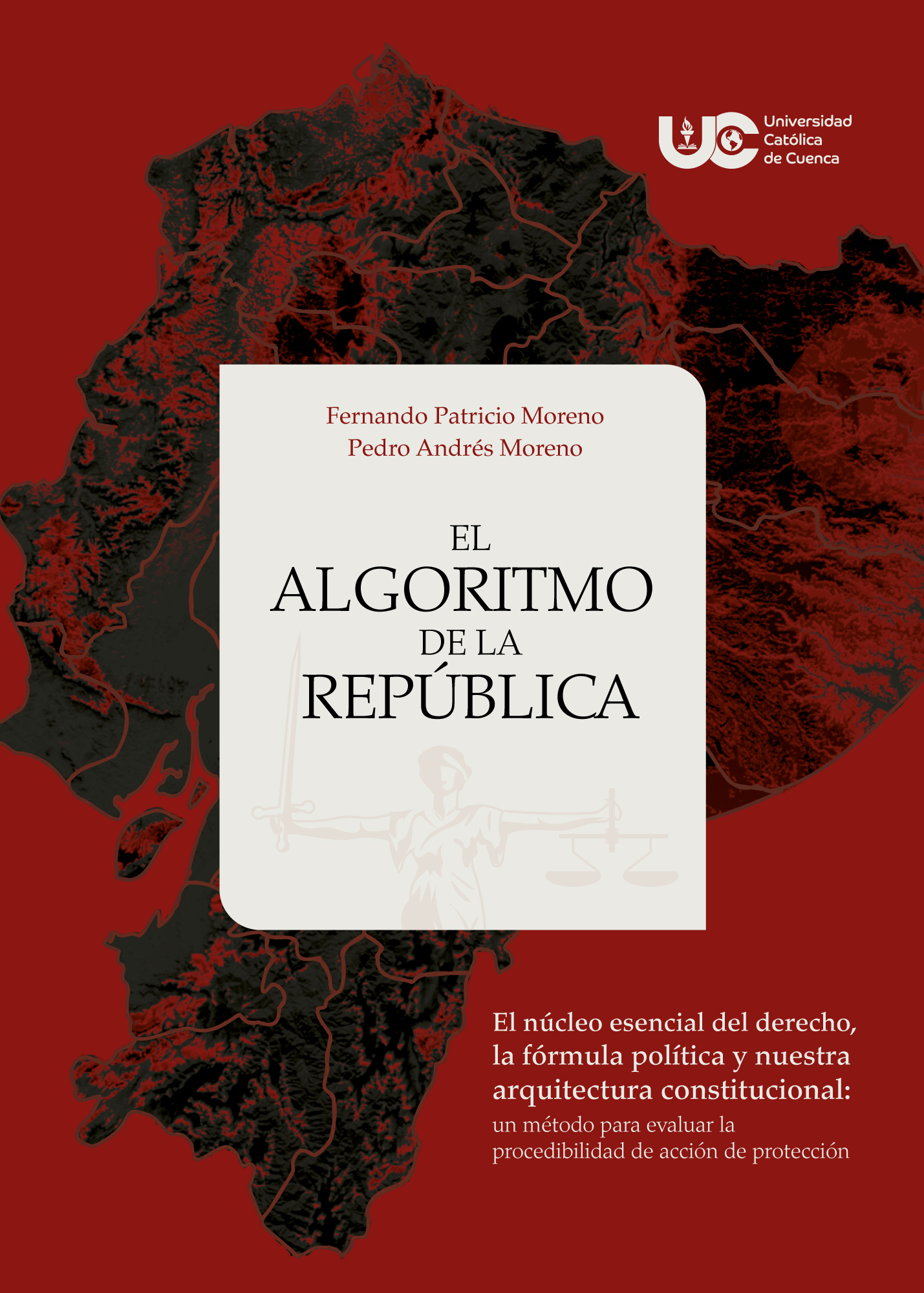
The Republic’s Algorithm: The Core of Law, the Political Framework, and Our Constitutional Architecture — A Method for Assessing the Admissibility of Constitutional Protection Claims
Keywords:
Fundamental rights, Essential core of rights, Constitutional protection action, Ecuadorian constitutionalism, Political formula, Constitutional theorySynopsis
This book examines the central problem of determining when a violation of fundamental rights occurs within the framework of Ecuadorian constitutionalism following the 2008 Constitution. Grounded in a neoconstitutionalist approach, it argues that the mere formal recognition of rights is insufficient without guarantees that ensure their effective normative force. In this context, the constitutional protection action raises a key methodological question: how to establish when an interference amounts to an actual constitutional violation.
The study identifies the limitations of constitutional jurisprudence and the principle of proportionality as tools for addressing this issue, and proposes instead a method based on the theory of the essential core of fundamental rights. Drawing on doctrinal, epistemological, and functional approaches, it develops the concept of the “constitutional political formula” as a criterion for identifying the constitutionally protected content of rights.
The book’s main contribution is the formulation of an operational method—referred to as the “algorithm of the Republic”—designed to assess the admissibility of constitutional protection claims. This method integrates structural analysis of rights, existing jurisprudential standards, and the identification of minimum constitutional thresholds. Ultimately, it aims to strengthen judicial practice, uphold constitutional supremacy, and enhance the coherence of rights protection in Ecuador.
Downloads
Download data is not yet available.
Published
April 14, 2026
Copyright (c) 2026 EDUNICA
Details about the available publication format: PDF
PDF
ISBN-13 (15)
978-9942-27-398-7


